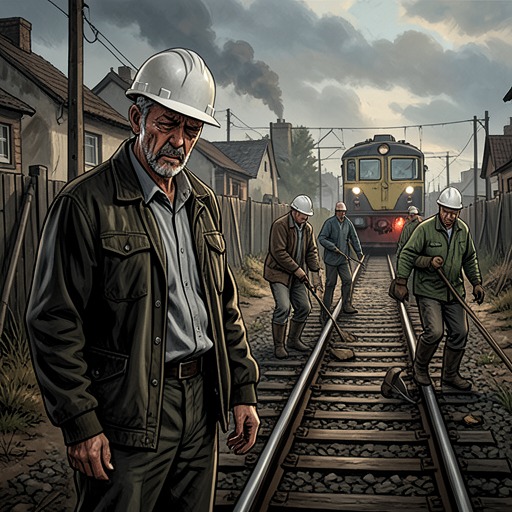
First train runs on the Burma Railway
The Narrow Road to the Deep NorthThe first train to travel the completed Death Railway ran on 25 October 1943, when steam locomotive C 5631 hauled three carriages of Japanese and Thai dignitaries along its full length. Its passage marked the completion of a project conceived as a strategic supply route, but the track crossed ground made by forced labor and human loss. The train’s ceremonial journey and the bones beneath its rails expose the distance between imperial achievement and the suffering that achievement required.
Strategic purpose and construction
The railway’s origins lay in Japan’s worsening military position. After the fall of Singapore in February 1942, the Japanese Empire sought a land route through Burma to supply its forces there and support its ambitions in India. The Allies were supplying the Chinese Nationalist Army through Burma, while American control of the seas constrained Japanese transport. Japan lacked the money, machinery, and time to build the railway by ordinary means; its leaders instead relied on military urgency and a vast forced labor force.
When Dorrigo Evans first saw the route in 1943, Imperial Japanese Army engineers had hammered surveyors’ pegs into the ground. The planned line ran 415 kilometres from north of Bangkok through to Burma. Prisoners were given blunt axes and rotten hemp rope and ordered to clear a kilometre of giant teak trees along the route. The railway existed first as plans, orders, and exhortations; its physical realization demanded the labor of people held captive and the destruction of the landscape through which it was driven.
The engineering requirements could change even as the work proceeded. At one major cutting, the Railway Command Group ordered the excavation enlarged by a third to address gradients in the next sector, adding another 3,000 cubic metres of rock to be cut and carried away. Prisoners worked by hand with hammers and chisels; there were too few tools, and inadequate coke prevented the sharpening of blunted chisels. The completed line was thus not simply the result of a fixed technical plan: changing specifications translated directly into more labor under already inadequate conditions.
The first journey and its human cost
By the time C 5631 made its journey, the railway had been built at a scale that dwarfed the dignitaries’ three-carriage train. Of 22,000 Australian prisoners of war, most captured after Singapore fell, 9,000 were sent to work on the railway. The first train passed what the narrative describes as endless beds of human bones, including the remains of one in three of those Australians.
Australian prisoners were only a fraction of the workforce. About 60,000 Allied prisoners of war labored on the project, alongside a quarter of a million or more Tamil, Chinese, Javanese, Malayan, Thai, and Burmese laborers. The number of Asian laborers who died remains disputed: estimates cited in the account range from 50,000 to 200,000. There is no agreed total. The uncertainty is not merely a problem of counting; the laborers’ names and experiences were already at risk of disappearing from the record.
The completion of the line therefore carried two opposed meanings. In railway terms, the first journey demonstrated that an immense construction project had been made operational. In human terms, it crossed a landscape marked by deaths that the achievement itself did not acknowledge. The train’s movement along the finished track did not resolve that contradiction; it made the contrast visible.
Commemoration and omission
C 5631 was later displayed in the museum at Yasukuni Shrine in Tokyo, which the narrative identifies as Japan’s unofficial national war memorial. The shrine also contains the Book of Souls, listing more than two million people who died in service to the Emperor of Japan in wars between 1867 and 1951. Among its names are 1,068 men convicted of war crimes after the Second World War and executed, including men found guilty of mistreating prisoners on the Death Railway. Enshrinement at the shrine is associated in the account with absolution from evil, placing commemoration and accountability in uneasy proximity.
The plaque in front of C 5631 says nothing about the railway’s construction or its dead. Nor does it name the hundreds of thousands who died building the line; even the total number of deaths has never been agreed. The locomotive can be preserved and displayed as an artifact, while the people whose labor carried it into history remain largely unrecorded. The contrast turns the first train’s later memorial setting into part of the event’s significance: the railway is remembered through a machine whose display does not tell the full story of the track it traversed.
Abandonment and afterlife
The railway’s military purpose disappeared with the defeat of the Japanese Empire. Within weeks of the war’s end, the line was abandoned by the Thais, dismantled by the English, and pulled up and sold by tribespeople. Its banks broke, bridges and embankments washed away, and cuttings filled in. The project that had been driven forward through forced labor did not endure as an intact infrastructure system; rain, vegetation, and time reclaimed its route.
A few short sections were later cleared and made into tourist, sacred, and national sites, but the larger line was broken and little of it remained. That physical unmaking sharpens the account’s judgment on the first journey: an immense expenditure of labor and life produced a railway whose strategic purpose vanished and whose surviving traces could not restore the dead to public memory. The line’s brief usefulness, later display, and eventual decay form a single history of construction, concealment, and loss.